
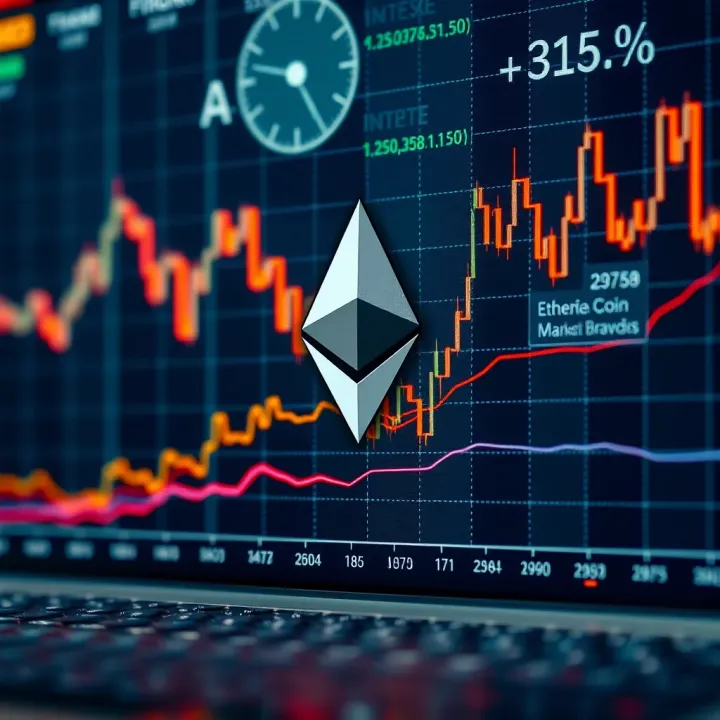
Ethereum Coin Price Prediction: Trends & Outlook
📈 Understand Ethereum (ETH) coin price trends, key factors affecting value, expert forecasts, and future risks for Indian and global investors planning to buy or sell ETH.
Edited By
Charlotte Spencer
Ethereum (ETH), the second largest cryptocurrency after Bitcoin, has captured significant attention from investors and traders in India and worldwide. Its price reflects a complex mix of market demand, technological progress, and regulatory developments. Understanding these price movements helps investors make well-informed decisions in the volatile crypto market.
Cryptocurrency prices tend to react quickly to changes in the broader market environment. Ethereum’s price often moves in tandem with Bitcoin, but it has its own drivers too. Factors such as upgrades to the Ethereum network, adoption of decentralised finance (DeFi) applications, and fluctuations in global risk appetite affect ETH’s value.

Ethereum’s price is shaped as much by innovation on its platform as by investor sentiment and global economic trends.
Network Upgrades: Major technological developments like Ethereum 2.0, which aims to improve scalability and reduce transaction fees, often spark price enthusiasm.
DeFi and NFTs Growth: Increased use of DeFi protocols and non-fungible tokens (NFTs), both largely built on Ethereum, drives demand and price.
Regulatory Changes: Announcements around cryptocurrency regulation in countries like India or the US can cause sharp price moves.
Market Sentiments: News cycles, global economic uncertainties, and investor psychology play a significant role in short-term price trends.
For traders and analysts, tracking the Ethereum price accurately is crucial. Real-time data from reliable Indian crypto exchanges like WazirX and international platforms such as Binance helps maintain an up-to-date view. Make use of price alerts and volume indicators to anticipate potential volatility.
By reviewing Ethereum’s price history, investors gain insights into its typical cycles and reactions to external shocks. For example, the 2021 bull run saw ETH surge over 1,50,000 in March, followed by notable corrections. Such data can guide timing decisions and risk management.
Grasping these fundamentals equips you better to navigate Ethereum’s price dynamics. This sets the stage for exploring deeper trends and investor strategies ahead.
Ethereum's price depends on several clear factors that influence its demand and value in the crypto market. Understanding these elements helps traders and investors assess when to buy or sell. For instance, if many buyers want ETH but few want to sell, the price rises due to high demand against limited supply.
Supply and demand form the bedrock of Ethereum's price movement. Unlike Bitcoin’s capped supply, Ethereum’s circulating coins increase with each mining or staking reward, but network upgrades like EIP-1559 have introduced a mechanism that burns a portion of transaction fees, reducing net supply over time. This balance between new issuance and burning affects available ETH, shaping price trends. For example, during periods of high DeFi activity on Ethereum, increased demand for ETH to pay gas fees often pushes prices up.
Technical improvements to the Ethereum blockchain, such as switching from Proof of Work to Proof of Stake, influence market confidence and the coin’s perceived value. When Ethereum transitioned to Ethereum 2.0 phases, expectations of lower energy use and faster transactions encouraged buyers. These upgrades often lead to speculation on future benefits, directly affecting ETH prices. Historical cases show price spikes following announcements of major upgrades, underscoring their impact.
Market moods shape Ethereum’s price swings significantly. Positive news about partnerships, increased adoption of decentralized applications (dApps), or optimistic forecasts often lead to price rallies. Conversely, fears about hacks, technical glitches, or competitor blockchains can cause prices to dip. Speculators amplify these trends by buying or selling based on short-term expectations, which adds volatility. For example, tweets from influential figures or sudden exchange listings may cause rapid price changes just based on sentiment rather than fundamentals.
Changes in regulations can make or break Ethereum’s market. Clear regulatory guidelines tend to boost confidence among institutional investors and retail participants, resulting in price gains. On the other hand, crackdowns or bans by major economies create uncertainty, triggering sell-offs. India’s evolving crypto rules, for example, have been a focal point for investors watching how potential GST or tax policies might affect trading volumes and, thus, price trends.
Understanding these drivers helps investors navigate Ethereum’s price fluctuations more wisely, making informed decisions rather than reacting impulsively to market noise.
By tracking supply-demand dynamics, technological shifts, sentiment waves, and regulatory changes, traders and advisors can better predict and react to Ethereum coin price movements in the fast-changing crypto environment.

Keeping a close eye on Ethereum's price is essential for traders and investors alike. The crypto market moves fast, and real-time access to price data helps you seize opportunities or avoid risks. Tools and platforms for tracking Ethereum price vary widely, but understanding their practical use lets you stay informed and act swiftly.
There are several reliable websites and apps that offer up-to-date Ethereum price information. Platforms like CoinGecko and CoinMarketCap provide comprehensive overviews, listing current prices, market cap, trading volume, and historical data. These sites compile data from multiple exchanges, giving you a broad market perspective. Mobile apps such as Delta or Blockfolio are handy for managing your cryptocurrency portfolio on the go while tracking live price movements.
For example, CoinGecko shows not only the price but also community statistics, developer activity, and liquidity metrics, offering deeper insights beyond price alone. This information helps you understand market trends and potential price movements more clearly.
Cryptocurrency exchanges like WazirX, Binance, and CoinDCX offer real-time Ethereum price charts based on actual trade data. Using exchanges for price updates is valuable if you want to trade Ether immediately since prices here reflect current buy and sell orders.
Most exchanges provide tools to view order books, recent trades, and price depth. These details show how much liquidity is available and whether significant players influence price swings. Being familiar with exchange interfaces ensures you can quickly spot price changes and execute orders effectively.
Besides, exchanges in India often offer INR trading pairs for ETH, making it simpler if you want to deposit or withdraw funds directly in Indian currency without currency conversion hassles.
Price charts are essential to track Ethereum’s past and current performance. Candlestick charts are most popular among traders for showing open, high, low, and close prices within given intervals like minutes, hours, or days. Watching candlestick patterns can reveal momentum shifts or potential reversals.
Technical indicators like Moving Averages (MA), Relative Strength Index (RSI), and Bollinger Bands help interpret price trends and volatility. For instance, an EMA crossover might suggest an upcoming price shift, while a high RSI points to an overbought condition, signalling a possible price drop.
Knowing how to read these charts and indicators helps you make data-driven decisions rather than relying on guesswork or hype.
In summary, using a mix of popular tracking websites, direct exchange data, and technical chart analysis equips you with the practical tools to monitor Ethereum price effectively. This combination supports timely decisions whether you are trading short term or planning long-term investments.
Understanding the historical price movement of Ethereum helps investors and analysts gauge its market behaviour and forecast potential trends. The journey from Ethereum's inception to its current status reveals insights about its resilience, market cycles, and factors driving volatility. Reviewing its past can also highlight how external events and technological shifts shaped price swings.
Ethereum launched in 2015 with an initial price of around $0.30 per coin, attracting interest mainly for its smart contract capabilities rather than immediate investment gains. During these years, the price stayed low, reflecting cautious market sentiment as the technology matured. However, community support and developer interest steadily increased, setting the stage for future growth. For example, the 2016 launch of the Decentralised Autonomous Organisation (DAO) attracted attention but also led to a significant hack, causing Ethereum’s price to dip and triggering a network hard fork.
Ethereum experienced several sharp price surges and corrections, reflecting its volatile nature. The 2017 bull run saw its price jump from about $8 in January to over $1,300 by January 2018. This rapid rise was driven by strong interest in initial coin offerings (ICOs) built on Ethereum’s platform. However, the subsequent crash wiped out much of these gains, with prices dropping below $100 by the end of 2018 due to regulatory uncertainty and reduced ICO activity.
Similarly, the 2020-21 period brought another surge, as decentralised finance (DeFi) projects and NFTs increased demand for Ethereum. Prices soared past $4,000 in May 2021, followed by corrections caused by global economic uncertainty and increased gas fees on the network. These cycles show the importance of understanding market hype and technological adoption for informed trading decisions.
In recent months, Ethereum’s price has shown signs of stabilising, partly influenced by upgrades like Ethereum 2.0, aiming to improve scalability and reduce high transaction costs. Investors are also observing how global factors such as inflation rates, interest rate changes, and crypto regulations in India and abroad affect sentiment.
Price behaviour now tends to reflect more measured growth, with institutional interest rising and greater liquidity on exchanges. Yet, given the broader crypto market’s sensitivity to news and policy shifts, short-term fluctuations remain common. Tracking these trends alongside Ethereum’s technical progress can help traders position themselves strategically.
Historical price analysis of Ethereum is essential not just for spotting past trends but for anticipating future moves in an evolving market influenced by technology, investor behaviour, and regulation.
By understanding Ethereum's price history, investors gain perspective on its risk profile and potential rewards, thus navigating its fluctuations with better confidence.
Before investing in Ethereum, understanding the factors that affect its performance and risks is essential. Ethereum's price can be volatile, and knowing what to expect helps in making informed decisions that suit your investment goals.
Ethereum is well-known for its price swings, which can be sharp and sudden. For instance, the price jumped from around ₹15,000 in January 2021 to over ₹3,00,000 by May, only to slide down considerably later. This volatility arises from market sentiment, technological news, and broader crypto trends. Investors need to be comfortable with such fluctuations. Risk management strategies like setting stop-loss limits can help mitigate downside losses.
Unlike some cryptocurrencies that mainly serve as digital money, Ethereum supports decentralised applications (DApps) and smart contracts. Real-world use cases such as DeFi (decentralised finance) and NFTs (non-fungible tokens) give Ethereum unique long-term value. If you believe in the expansion of these services and Ethereum's role in Web3, this could justify holding it as a long-term bet. However, keep in mind that competing blockchains and scalability challenges may affect its future trajectory.
Putting all eggs in one basket is risky, especially in the crypto world. Diversifying your portfolio with other cryptocurrencies such as Bitcoin, Binance Coin, or emerging tokens can spread risk. Cryptos behave differently under various market conditions; some may perform better when Ethereum struggles and vice versa. For example, a balanced portfolio could include 50% Ethereum, 30% Bitcoin, and 20% stablecoins or smaller altcoins.
The government and tax authorities in India have started paying closer attention to cryptocurrency transactions. As per current tax rules, gains from crypto are taxed at a flat rate of 30%, without allowance for losses to offset profits elsewhere. In addition, a 1% tax deducted at source (TDS) applies to crypto transactions above a certain threshold. It’s vital to maintain clear records of your trades and consult a tax advisor. Regulations may evolve, so staying updated helps you avoid compliance issues.
When investing in Ethereum, balancing potential rewards with risks and understanding the Indian regulatory landscape makes a significant difference in safeguarding your investment and capitalising on growth opportunities.
Taking the time to evaluate these considerations before investing can protect you from surprises and set clear expectations about your Ethereum portfolio's future.
Predicting the future of Ethereum coin price involves examining factors likely to influence its market value. This section focuses on tangible elements that traders and investors should watch closely to anticipate price movements. Understanding such drivers helps avoid blind bets and guides informed decision-making, especially in a volatile crypto market.
Ethereum's price often reacts to changes in its underlying technology. The network's upcoming upgrades, like the transition from proof-of-work to proof-of-stake consensus through Ethereum 2.0 phases, aim to enhance scalability and reduce transaction fees. These improvements can boost adoption by lowering costs for developers and users. For instance, the Beacon Chain launch already set a foundation for energy-efficient mining, drawing attention from environmentally conscious investors. Similar innovations introduce smart contract improvements and sharding, which could enhance throughput and reliability. Each such advancement typically leads to renewed market interest and price appreciation, albeit sometimes accompanied by short-term volatility.
The broader acceptance of Ethereum by businesses and developers impacts its long-term value. Growth in decentralized finance (DeFi), non-fungible tokens (NFTs), and enterprise blockchain solutions contribute to increased demand for ETH. Diverse applications build a robust ecosystem that sustains network usage and transaction volume. For example, platforms utilising Ethereum for tokenisation or supply chain management create persistent demand for the coin to pay gas fees. As more Indian startups and global firms integrate Ethereum-based solutions, investor confidence grows. Additionally, partnerships between traditional finance and blockchain increase legitimacy, influencing price positively.
Ethereum's price doesn't move in isolation. Events like inflation surges, central bank policies, or geopolitical tensions indirectly shape crypto markets. For instance, during periods of fiat currency depreciation or economic uncertainty, investors may turn to cryptocurrencies including Ethereum as alternative assets. Furthermore, regulatory shifts around the world—whether tighter controls or clearer guidelines—alter investor sentiment and liquidity. Market trends, such as the rise of layer-two scaling solutions or competition from other smart contract platforms like Solana or Cardano, also matter. Keeping an eye on how these external forces interact with Ethereum's fundamentals is crucial for timely investment strategies.
Staying updated on these factors equips traders and analysts to respond swiftly to market shifts, reducing risks and maximising growth opportunities.
In summary, Ethereum's future price depends on continuous tech upgrades, expanding real-world use cases, and broader economic influences. Investors who analyse these areas can better predict price behaviour and plan their moves accordingly.
📈 Understand Ethereum (ETH) coin price trends, key factors affecting value, expert forecasts, and future risks for Indian and global investors planning to buy or sell ETH.
Explore Ethereum price prediction for 2040 🔮, analysing market trends, tech advances, economic factors & risks to guide your long-term crypto investments 📈.
Explore BTT price trends 📊, factors influencing value, historical data, and investment tips tailored for Indian crypto enthusiasts interested in trading or holding BTT tokens.
📊 Explore Bitcoin price trends this week with expert insights, market analysis, global events impact, and crypto regulations shaping trader and investor decisions.
Based on 11 reviews